

In this tradgrip.com review, we will examine how the broker actually treats its clients. It presents itself as a platform with modern technology, fast execution, and diverse instruments, but we will check whether its services are truly reliable and profitable or if there are hidden risks behind the marketing.
Company Highlights
| Official Website | https://www.tradgrip.com/ |
| Company Name | Zenith Markets PLC |
| License Status | Yes, MISA |
| Account Types | Silver, Gold, Platinum |
| Demo Account | Available |
| Assets Offered | CFDs |
| Leverage | 1:200 |
| Trading Platform | WebTrader |
| Deposit Methods | Bank cards, wire transfers, e-transfers |
| Withdrawal Time | Up to 5-7 days |
| Affiliate Program | None |
Key TradGrip Trading Features
TradGrip’s website presents three account types — Silver, Gold, and Platinum. At first glance, the broker seems to provide a fairly detailed comparison table. However, in reality, the information is clearly incomplete and does not allow for an objective assessment of the trading conditions. For example, the Silver account offers leverage of up to 1:200, a minimum lot size of 0.01, and a stop-out level set at 5%. At the same time, there are no discounts on swaps or spreads in this package.
The Gold account is positioned as a more favorable option, where clients receive a 40% swap discount compared to the base level, along with reduced spreads (approximately half the size of those in Silver). Otherwise, the conditions remain the same: leverage up to 1:200, minimum lot size 0.01, and stop-out at 5%.
Platinum, in turn, provides even larger benefits, up to 60% swap discounts and up to 75% spread reductions compared to the base account. While this may appear to be a premium-tier option, in practice there are no real differences in the core parameters such as leverage or minimum trade size.
At the same time, crucial details that usually matter most to traders are not disclosed at all.

Ultimately, TradGrip’s account structure leaves much to be desired.
Overview of Available Trading Instruments
When it comes to the range of trading instruments, TradGrip focuses entirely on CFDs. According to the broker, clients can access various asset classes — currencies, indices, commodities, and possibly shares, but all of them are provided exclusively in CFD format.
This means that traders do not actually own the underlying assets, but speculate on price movements. While such an approach allows for flexibility, including the use of leverage and the ability to profit in both rising and falling markets, it also comes with significant drawbacks.
The first issue is that CFDs are considered high-risk instruments. A leverage ratio of up to 1:200, which is advertised by TradGrip, can multiply both profits and losses. Another problem is that CFD trading depends entirely on the broker’s execution and pricing policies. Since all transactions remain within the platform itself, traders are reliant on the broker’s honesty and transparency. If spreads, commissions, or liquidity sources are not clearly disclosed (and in TradGrip’s case they are not) it becomes nearly impossible to verify whether the conditions are fair.
Tradgrip.com Trading Platform Analysis
TradGrip makes ambitious claims about its trading technology, promising unlimited access across devices and even highlighting a dedicated mobile app. On the website, the platform is described as robust, user-friendly, and fully functional on desktop, tablet, and smartphone.
However, in reality, these statements do not hold up to scrutiny. The broker only provides a basic web-based trader, and no standalone applications are available for download. When attempting to access the so-called mobile app, users are simply redirected to the registration page instead of an actual application store or download link.
Additional Services
When it comes to extra services, TradGrip leaves traders with almost nothing of value. A reliable broker usually offers features such as educational resources, research materials, trading signals, or risk management tools that help clients. Here, however, none of these are provided.
The only additional service mentioned is a vague reference to bonuses and promotions in the Terms and Conditions. Even then, the wording is deliberately unclear: the company reserves the right to grant bonuses, and clients are advised to check the website for possible updates. There are no details about the size of bonuses, their conditions, or withdrawal rules. This lack of transparency is typical of offshore brokers, where so-called bonuses often turn into obstacles that lock traders’ funds until unrealistic turnover requirements are met.
Fee Structure. Are You Paying More Than You Should?
One of the most striking issues with TradGrip is the inconsistency in how it communicates fees and processing times. On the FAQ page, the broker claims that deposits are free of charge. However, the official Client Agreement paints a very different picture. There it is explicitly stated that the company may charge a 3% + $0.25 fee per deposit, justified as a combination of service provider and handling costs. This essentially means that traders could be paying one of the highest deposit fees in the industry and this is something entirely absent from the FAQ.
These inconsistencies create the impression that the broker deliberately downplays or hides unfavorable conditions in its marketing materials, while the legally binding documents reveal the real costs and delays. For a trader, this serves as a critical reminder: always check the formal agreements rather than relying on reassuring but non-binding website statements.
Legitimacy of TradGrip
TradGrip claims to operate legally through Zenith Markets PLC, a company registered in the Comoros Islands, Mwali. Formally, the broker has obtained a license from the Mwali International Services Authority, which is mentioned on its website.

However, this registration and license cannot be considered a reliable safeguard for clients. MISA is a little-known regulator that functions more as a company registrar than a true financial oversight body. Obtaining a license here is relatively easy. A fee is paid, and annual renewal is required, with no strict requirements for financial reporting, client fund segregation, or trader protection.
In practice, a Mwali license is often used by offshore brokers merely to create the appearance of legitimacy. Unlike reputable regulators, MISA does not oversee trade execution, does not require segregated accounts, and provides no compensation schemes.
The Broker’s Past and Present
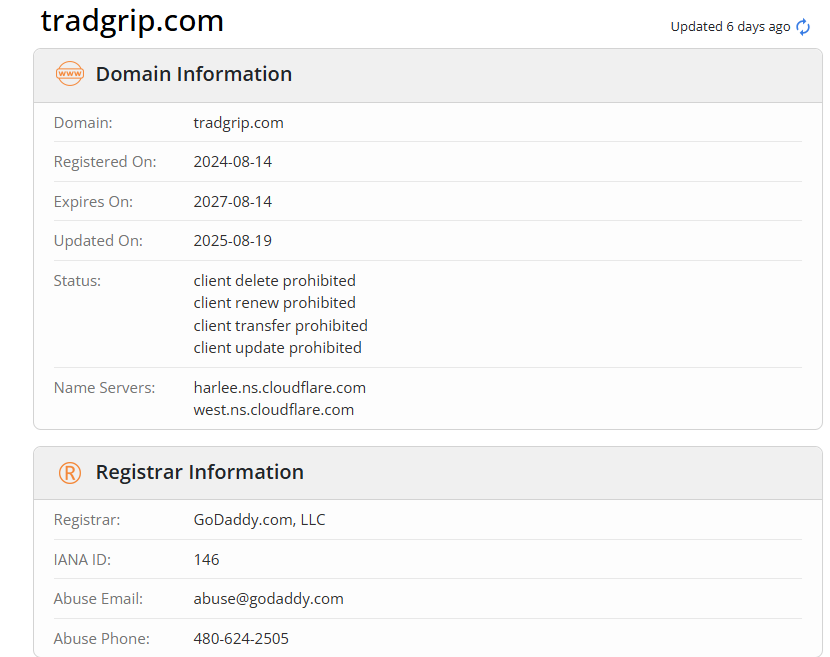
TradGrip presents itself as an established broker, but the reality is quite different. The company’s actual operational history is very short and does not allow it to claim any significant market presence. The project’s domain was registered on August 14, 2024, and the platform itself was launched only sometime after that.
Given this timeline, it is premature to consider TradGrip a leading or experienced participant in the trading industry. The broker has not yet demonstrated consistent performance or earned a reputation as a reliable market player. Any claims suggesting long-standing expertise should be taken with caution, as the project is still in its early stages of operation.
Conclusion
In conclusion, TradGrip shows multiple signs of being an unreliable platform. Its offshore registration with a MISA license offers little real security and trading conditions are unclear. The company has a very short operational history and contradictory statements regarding fees and withdrawals. Overall, engaging with this platform is highly risky.
Weighing the Pros and Cons
-
Offers a range of CFD instruments.
-
The platform appears modern and visually appealing.
-
Operates under an offshore MISA license and offers minimal protection.
-
Trading conditions are unclear, spreads, leverage per instrument, and minimum deposits are not disclosed.
-
Fees and withdrawal terms are inconsistent across different documents.
-
Short operational history.
-
Additional services and client support are minimal.
Common Questions
How fast are deposits and withdrawals processed?
On its FAQ page, TradGrip promises deposit processing without fees and withdrawals within 72 hours. However, the official agreement states otherwise, indicating possible deposit charges of 3% plus fixed costs and withdrawal times stretched to 5–7 business days.
What trading conditions can clients expect?
TradGrip advertises flexible account types, but key parameters and exact spreads are not disclosed. Without this information, traders cannot accurately assess costs or compare conditions with other brokers.

I deposited $400 here, thinking I’d give trading a try, but it turned out to be the dumbest mistake I’ve ever made. At first everything seemed fine. No lags, nothing suspicious, and they even showed some profit. I managed to grow my balance by about 50%. Then I tried to withdraw my initial deposit. That’s when they started asking for extra documents and eventually blocked my account under the pretext of a “security check.” I still haven’t gotten my money back. For now, I’m only in touch with support, but we’ll see how that goes.