

In today’s saintmarycptl.com review, we will discuss yet another scam broker that promises traders expert assistance in achieving their financial goals. Naturally, potential clients are offered the most favorable trading conditions, exceptional order execution speed, and top-quality educational materials. However, we are confident that this project can only lead to financial losses. What is wrong with this company? You will find all the answers below.
Highlights
| Official Website | https://saintmarycptl.com/ |
| Company Name | St.Mary Capital |
| License Status | None |
| Account Types | Basic, Silver, Gold, Platinum, VIP, Staking PRO, Arbitrage |
| Demo Account | None |
| Assets Offered | Currencies, CFD on stocks, commodities, indices, crypto |
| Leverage | Up to 1:300 |
| Trading Platform | Native Webtrader |
| Deposit Methods | Crypto |
| Withdrawal Time | 7-10 working days |
| Affiliate Program | Available |
Key St. Mary Capital Trading Features
We know very well what potential clients of brokers are primarily interested in. That is why we started our review of the project with its trading conditions. Naturally, we expected to find detailed information on the platform’s website. However, at St. Mary Capital, as with most other scam brokers, the specifications of contracts are either unknown or deliberately undisclosed. The account type descriptions include only some of the key parameters for each plan:
- Minimum deposit.
- Maximum leverage.
- Minimum spreads.
- Swap (rollover) fees.
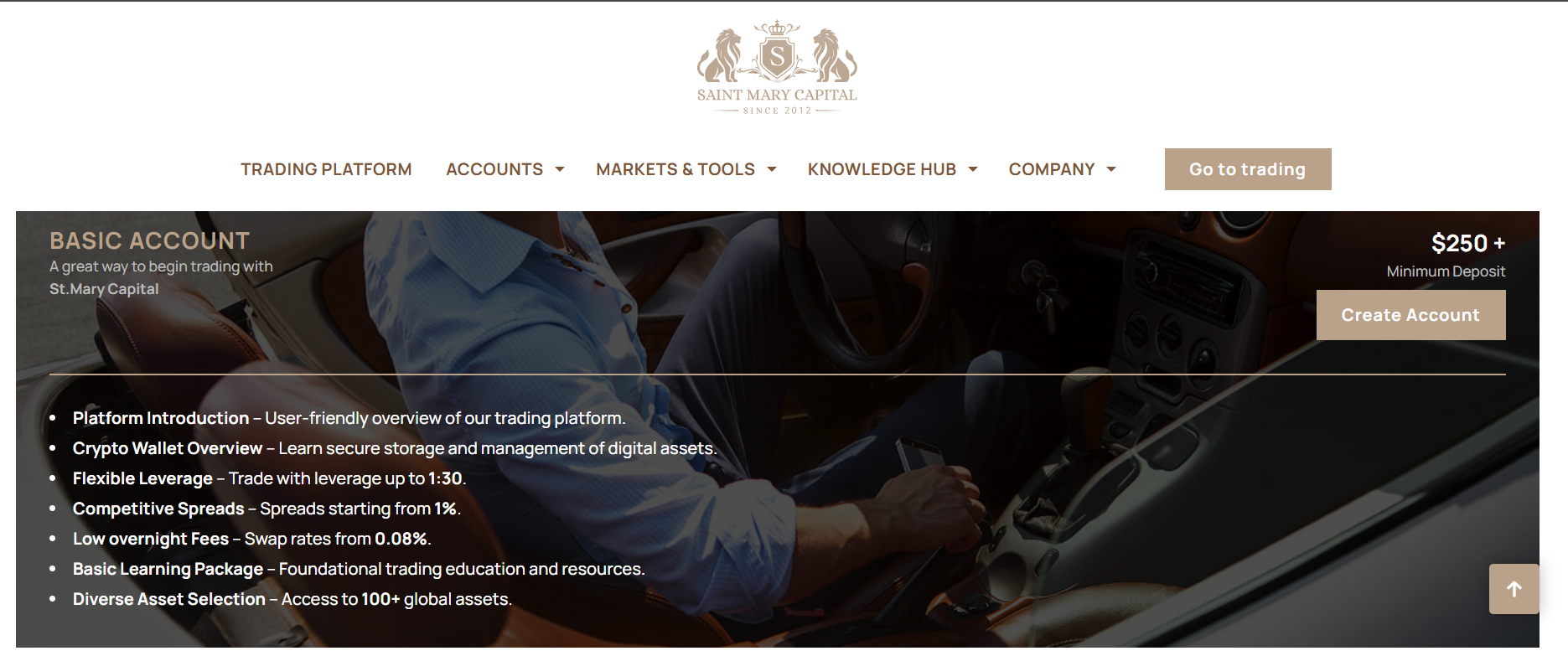
The broker offers five account types:
- Basic: minimum deposit $250, maximum leverage 1:30, spreads from 1%, swaps from 0.08%.
- Silver: deposit from $10,000, leverage up to 1:100, 25% discount on swaps (minimum spread 0.75%), swaps 0.7%.
- Gold: entry threshold $50,000, leverage up to 1:200, spreads and swaps reduced to 0.6% and 0.05% respectively.
- Platinum: deposit from $100,000, maximum leverage 1:300, spreads from 0.5%, swaps 0.04%.
- VIP: for high-net-worth clients, available by invitation only; account characteristics provided by a personal account manager.
Of course, these options are far from the full set of services included in the account descriptions. Such offers, along with different levels of trading education or participation in trading sessions with experts, might appeal to beginners who lack the necessary knowledge to trade independently. Experienced traders would prefer more detailed information about deal parameters, but it seems scammers are not particularly interested in such clients, and their opinion doesn’t matter here.

The situation with spreads is even more outrageous. On the Basic account, spreads start at 1%. Let’s calculate: with a deposit of $250 and leverage of 1:30, a trader can open a position worth $7,500 (or up to 0.07 standard lots). This means that with a 1% spread, the trader will pay $75 when opening the position. Meanwhile, their profit is 70 cents per pip. In other words, they need a gain of 107 pips just to cover the spread. Not every asset can move this much within a single day. If positions are held longer, costs increase due to swap fees.
What does this mean? It is practically impossible to make a profit on the lowest account, so clients will naturally start moving to higher tiers. But activating the next tier requires a deposit 40 times larger! Even there, the conditions are not much better (covering the spread still requires 70 pips of profit), and swap fees will increase costs, albeit more slowly. Acceptable conditions can only be achieved on the Platinum account, but how many traders do you know who are willing to risk $100,000?
Overview of Available Trading Instruments
The list of tradable assets at St. Mary Capital includes six groups:
- Forex currency pairs.
- CFDs on commodity market assets.
- CFDs on stocks.
- CFDs on indices.
- CFDs on cryptocurrencies.
- CFDs on exchange-traded funds (ETFs).
The last category is perhaps the only feature that sets this company apart from most other scam projects. However, it is worth noting immediately that in the account types, users are promised a maximum of 250 instruments (on the Platinum account).
At the same time, there is hardly any discussion about actually using the maximum number of interesting assets. For example, the list of cryptocurrencies includes only about 50 pairs with the US dollar. Needless to say, this is less than 1% of the crypto market. There are also no cryptocurrency pairs that would help traders achieve higher returns.
What’s more, the broker did not provide on the website pages either a list of instruments or such simple but essential information for traders as contract specifications. This demonstrates both the company’s attitude towards its clients and the professionalism of its staff. All of this leads to the inevitable conclusion: the project owners care about nothing except the money they can obtain from deceived users.
Saintmarycptl.com Trading Platform Analysis
One glance was enough to understand: the broker’s trading terminal is far from original; this software is widely used by scam platforms. We have seen it many times and know the platform’s problems well.
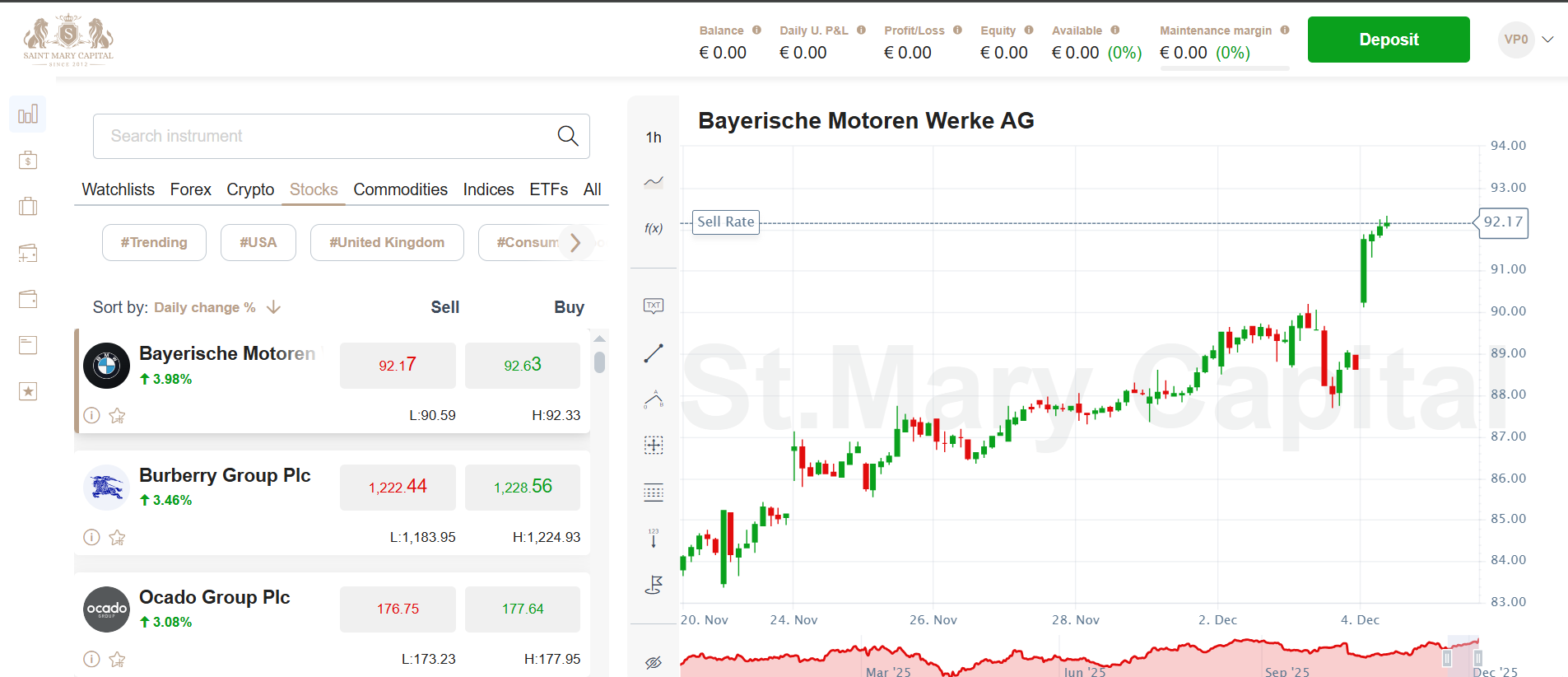
For example:
- In the chart window, it is only possible to open a single chart. For clients managing a portfolio of instruments, this will waste time and, most likely, money when switching between symbols on a dynamic market.
- Users can configure the price chart (select the timeframe, chart type, indicators, and graphical objects) fairly quickly. However, the settings are only saved until the end of the current browser session. At the beginning of a new session, the process must be repeated.
- The terminal does not provide the ability to open/close positions with one click.
- Developing custom indicators or connecting third-party indicators and trading robots is also impossible. The platform’s creators decided that traders working with scam brokers do not need these capabilities.
Additional Services
Interestingly, in the account list at St. Mary Capital, there are a couple of attractive offers. These are the Staking PRO and Arbitrage accounts. The first involves placing clients’ funds in staking pools and earning profits without entering trading deals. The second uses crypto arbitrage technology, which allegedly provides quick profits with almost zero risks. However, the company limits itself to verbose descriptions of these offers, without providing specific data.

There is slightly more specificity with the referral program. The company promises 10% of a new client’s deposits to everyone who attracts a new client, but not more than $25,000. At the same time, every referred client receives a 5% bonus when making each deposit.
Fee Structure. Are You Paying More Than You Should?
We have already discussed the trading costs for a trader working with St. Mary Capital. The broker does not charge any fees for opening or maintaining an account, nor for deposits (except for payment system fees, which are paid by the client themselves).
However, the firm is less modest when it comes to withdrawals. It withholds 1% from each withdrawal operation, but not less than $30 (or €30, £30) and not more than $300 (or €300, £300). At the same time, all payment system fees are also charged to the trader’s account.
Legitimacy of St. Mary Capital
The broker does not publish information on the company’s registration or its licenses on the website. However, when reviewing the Terms & Conditions, we discovered that the firm states it operates in accordance with the laws of Saint Vincent and the Grenadines and that disputes are subject to the jurisdiction of the courts of this Caribbean state. Typically, this implies that the company is registered in this country. However, a check in the local financial regulator’s (SVGFSA) database showed no records of a company named St. Mary Capital or anything similar.
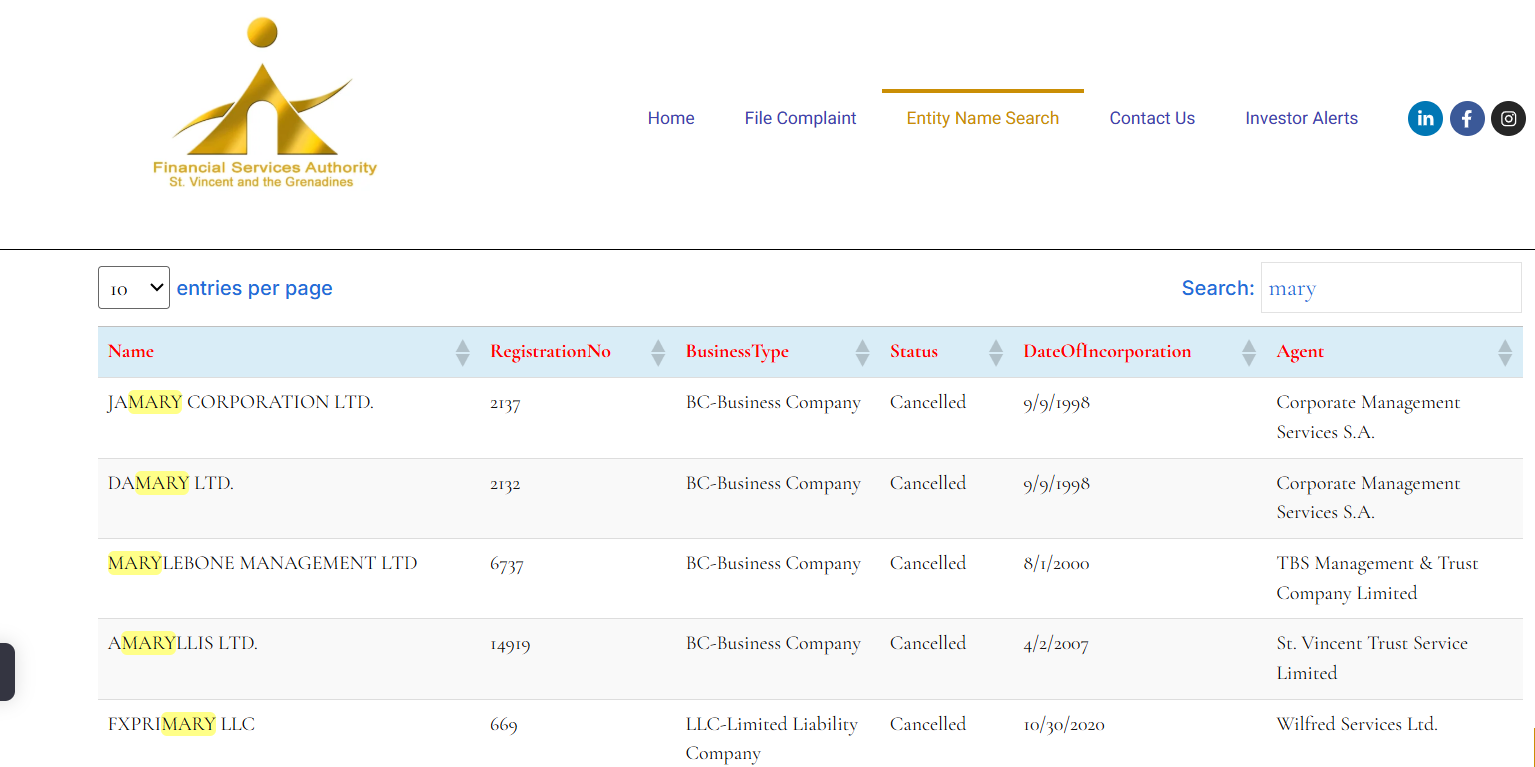
We could have also checked the database of the UK Companies House, since the broker listed a UK phone number on the contacts page. However, we decided to conduct a broader search using the global aggregator OpenCorporates.
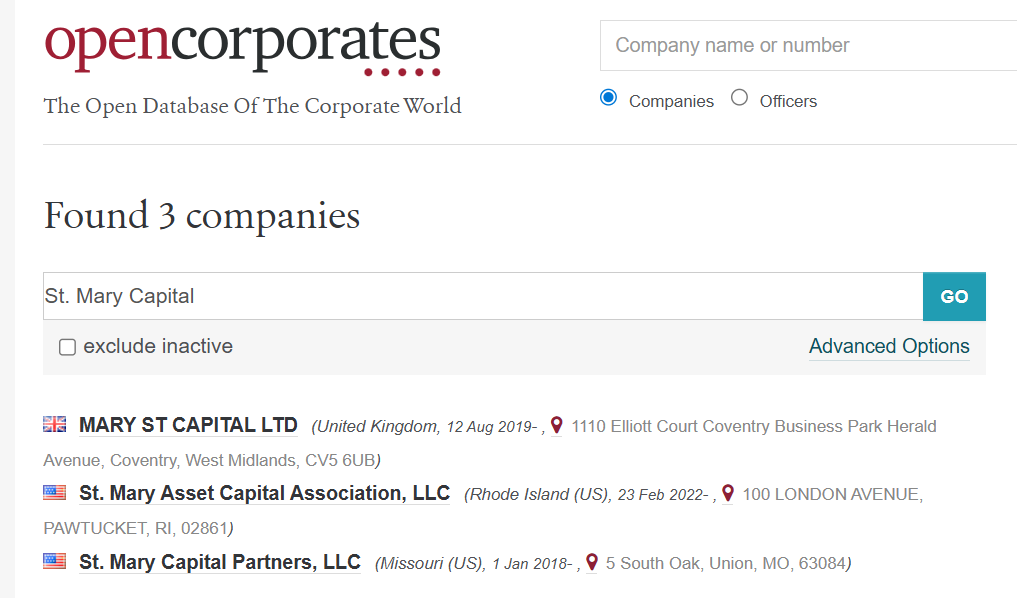
As we can see, a search among 223+ million corporate records worldwide returned only three relevant results. Two of them, which refer to American companies, can be disregarded since CFD trading is prohibited by law in the USA. That leaves only the UK company. Its record in Companies House shows that the firm works with credit grants and, accordingly, cannot provide brokerage services in the Forex/CFD market.
The Broker’s Past and Present
On the homepage of the official St. Mary Capital website, the company proudly claims to have been operating in the market for over 10 years. These statements can easily be verified using the WHOIS service for domain registration.
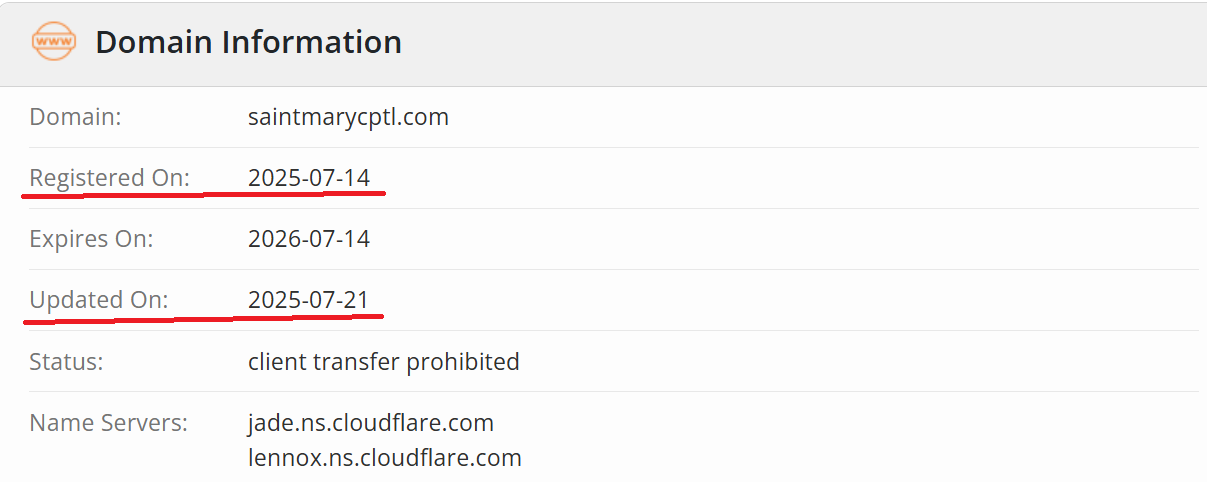
According to WHOIS data, the domain saintmarycptl.com was registered on July 14, 2025, and the official website, judging by the date of the last significant update, went live about a week later. From that point until the writing of our review, just over four months have passed. This completely contradicts the company’s claim of a 10-year operating history.
The statistics published by the broker also do not hold up. It claims to have 500,000 registered clients. However, it would be impossible to gather such an audience in such a short time (this would require nearly 125,000 registrations per month on average, or more than 4,000 per day, which is virtually unattainable for any website). The information about assets under management also appears implausible. For this to be true, each trader would have had to deposit an average of $5,000. If the actual number of registered users is much lower, their deposits would need to be several times larger.
Conclusion
In our St. Mary Capital review, we found enough signs indicating that this is a project created by scammers. All evidence points to the fact that traders will not get their money back from this broker. Indeed, it would be at least strange if a platform without registration and a license were actually paying profits or processing withdrawals. Such activity is likely possible only in the form of paid-for positive reviews, but we know well how trustworthy these are.
Weighing the Pros and Cons
-
An accessible entry threshold (just $250) suitable for almost any trader.
-
An impressive range of account types, complemented by attractive offers.
-
The broker operates without registration; all it has is an official website providing virtual services.
-
The virtual firm cannot even obtain an offshore license, making all its activities illegal.
-
The statistics on the website are unreliable, as is the vast majority of information about the company itself.
-
The trading conditions are unrealistic, and the risks for clients participating in trades are enormous.
-
The project owners consider it acceptable to build the broker’s image through paid-for reviews rather than honest trading.
Common Questions
How risky is a leverage of 1:300 from a trader’s perspective?
In our view, trading with such leverage is not advisable. While it can potentially increase trade profitability, for a trader, this is far from the only concern: the leverage exceeds the acceptable level even for professional investors/traders. According to limits set by reputable regulators for retail clients of brokers, the leverage offered here surpasses those limits by an order of magnitude. High leverage carries risks beyond acceptable levels, and the probability of losing the entire account in just a few trades approaches 100%.
Can you test trading with this broker using the minimum initial deposit account?
The answer depends on what you want to find out. If your goal is to see whether the broker actually pays out, you still won’t get a definite answer. The minimum deposit of $250 is negligible, even compared to the next account type. Therefore, the company can easily allow withdrawals of both trading profits and the full deposit to build a reputation. If you are interested in the specifics of trading conditions, you can get all the necessary answers, but precise terms can only be confirmed after opening the corresponding account. Therefore, we see no reason to risk even such a small sum.

The managers from St. Mary Capital called me themselves and were very convincing. They described everything so vividly that I agreed to deposit not the minimum I initially intended, but a full $25,000. I shouldn’t have rushed; I should have checked the broker first, but it didn’t occur to me at the time. I regretted everything when I tried to withdraw $2,000 and my request was denied. That’s when I realized who I was dealing with. Now I am certain that the scammers will never return my invested funds, unfortunately…
Honestly, I’ve never seen more blatant scammers. Even the registration on an island is fake (it doesn’t exist, but the documents claim it does). I don’t understand where all the positive comments about St. Mary Capital come from—were they paid for?? The scammers took $12,000 from me, and I received absolutely nothing in return! Trading is inconvenient, spreads are astronomical, and making a profit is virtually impossible! On top of that, withdrawals are a problem. I wish I had never dealt with them; my money and nerves would have been safe.